
By Iain Russell, Patent Attorney and Director at Russell IP (BSc, CPA, EPA, FRSA – 20 years’ experience in computer-implemented inventions and music technology), and member of the Computer Technology Committee (CTC) of the Chartered Institute of Patent Attorneys.
What Does The New IPO Practice Notice Following Emotional Perception Mean For UK Software And AI Patents?
Published: September 2026 | Last updated: September 2026
The UK Intellectual Property Office (IPO) has published a new practice notice, Search and Examination of UK Patent Applications under the Patents Act 1977 (as amended), setting out how examiners should search and examine UK patent applications following the Supreme Court’s judgment in Emotional Perception AI Limited v Comptroller General of Patents, Designs and Trade Marks [2026] UKSC 3.
This is a significant development for UK software patents, and for anyone seeking to protect AI, machine learning, and other computer-implemented inventions.
In this post, we summarise what has changed and what it may mean for applicants.
Key Takeaways
- The IPO’s practice notice of 14 July 2026 sets out how examiners should search and examine UK patent applications following the Supreme Court’s judgment in Emotional Perception.
- Examiners have been instructed not to apply the previous Aerotel approach, and to follow instead a three-step approach aligned with EPO case law.
- In many cases, the eligibility hurdle for UK software and AI patents will now be easier to clear, but only features contributing to the technical character of an invention can support an inventive step.
- Where an excluded matter objection was raised under the old approach, examiners will reconsider patentability afresh once the applicant responds, so pending applications may be worth revisiting.
This article is a general guide to a change in UK patent examination practice. It is not legal advice. Every invention and patent strategy is different. If you need advice on your specific situation, please contact Russell IP to discuss your circumstances.
Contents
- What has changed at the UK IPO?
- The three-step approach explained
- What does this mean for software and AI patent applicants?
- What about pending applications with excluded matter objections?
- What questions remain open?
- Frequently Asked Questions
What Has Changed At The UK IPO?
The IPO has instructed its examiners to stop applying the long-standing Aerotel approach to the exclusions from patentability, and to follow instead a three-step approach aligned with the case law of the European Patent Office (EPO), notably the Enlarged Board of Appeal’s decision in G 1/19.
The change comes from the Supreme Court’s judgment in Emotional Perception, handed down on 11 February 2026. The IPO notes that the judgment brought about an immediate change to how section 1 of the Patents Act 1977 should be interpreted and applied. The practice notice, published on 14 July 2026, summarises the judgment and instructs examiners on how to apply it in practice.
In our own cases, we have already seen IPO examination reports applying the Emotional Perception approach.
The Three-Step Approach Explained
In outline, the three steps set out in the practice notice are as follows.
Step 1: Eligibility – The First Hurdle
Examiners decide whether the claimed subject matter is an “invention” at all, using an “any hardware” approach. Under the notice, an objection that subject matter is excluded arises only where a claim involves no technical means at all. Technical means include, for example, some form of computer hardware.
Step 2: The Intermediate Step
Examiners identify which features of the claim contribute to the technical character of the invention as a whole.
Step 3: Novelty and Inventive Step – The Second Hurdle
Examiners assess novelty and inventive step using existing UK law, including the Pozzoli approach, which the Supreme Court left unchanged. Only features that contribute to the technical character of the invention can support the presence of an inventive step.
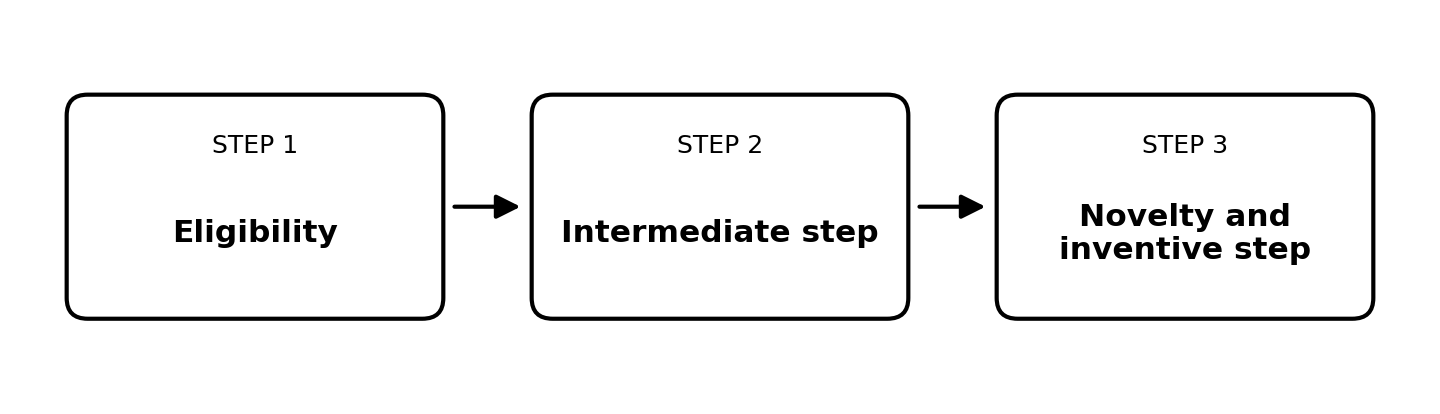
The three-step approach set out in the IPO’s practice notice following Emotional Perception.
The Manual of Patent Practice will be updated in due course to reflect the notice.
We welcome this additional guidance. Clear direction from the IPO helps applicants and attorneys navigate a significant change, and closer alignment with the EPO may bring greater consistency for those filing in both systems. We will be monitoring how application of the new approach develops in practice, both through our client work at Russell IP and through Iain’s role as a member of the Computer Technology Committee (CTC) of the Chartered Institute of Patent Attorneys (CIPA), CIPA’s specialist committee on legal and practice issues in information technology and the IP protection of innovations in the IT field. Iain’s membership of the CTC reflects Russell IP’s ongoing commitment to the protection of computer technology, from software, AI, and machine learning to other areas of information technology.
What Does This Mean For Software And AI Patent Applicants?
In many cases, the eligibility hurdle will now be easier to clear than under the previous approach, but that does not necessarily make patents easier to obtain overall.
Under the notice, a claim involving technical means is an “invention” and avoids exclusion; the substantive assessment then turns on novelty and, in particular, inventive step, where only features contributing to the technical character of the invention can support an inventive step. The outcome for any individual application will therefore depend on the specific claims and the prior art.
For AI specifically, the Supreme Court held that an artificial neural network is a “program for a computer” for the purposes of the Act, however it is implemented, and that instructions generated by machine learning are computer programs just as human-written code is. Even so, the claims in Emotional Perception itself passed the eligibility test, because they involved technical means such as a database, a communications network, and a user device.
What About Pending Applications With Excluded Matter Objections?
Where an examiner previously raised an objection that an invention was excluded under the Aerotel approach, the practice notice instructs examiners to reconsider the requirements for patentability afresh under the new approach once the applicant responds to that objection.
If you have a pending application that received an excluded matter objection under the old approach, it may be worth reviewing your application and response strategy in light of the change.
What Questions Remain Open?
Some questions remain open. The Supreme Court considered it inappropriate to define the intermediate step further, and remitted key questions in the Emotional Perception case back to the hearing officer at the IPO, including how the intermediate step applies to the specific claims at issue.
How the new approach works in practice will therefore become clearer over time. We will share further updates as they emerge, including when the Manual of Patent Practice is revised.
In the meantime, if you are considering a new patent application in this area, our posts on software patent drawings and AI in IP may also be useful background.
If you would like to discuss how the change affects your applications or filing strategy, contact Russell IP today for a free, no-obligation discussion.
Disclaimer: This article is general information, not legal advice. For tailored guidance, please contact Russell IP.
Frequently Asked Questions About The New IPO Practice Notice
What is the IPO’s new practice notice on search and examination?
It is guidance published by the UK Intellectual Property Office on 14 July 2026, titled Search and Examination of UK Patent Applications under the Patents Act 1977 (as amended). It sets out how examiners should search and examine UK patent applications following the Supreme Court’s judgment in Emotional Perception, and is particularly relevant to software, AI, and other computer-implemented inventions.
Does the Aerotel test still apply to UK patent applications?
No. In Emotional Perception, the Supreme Court held that the Aerotel approach should no longer be followed. The practice notice instructs IPO examiners not to apply it, and to follow instead a three-step approach aligned with EPO case law – notably the Enlarged Board of Appeal’s decision in G 1/19.
Is the UK IPO already applying the Emotional Perception approach?
In our experience, yes. The judgment brought about an immediate change when it was handed down on 11 February 2026, and we have seen IPO examination reports applying the Emotional Perception approach in practice. The practice notice published on 14 July 2026 sets out how examiners should apply it.
Are software and AI inventions now easier to patent in the UK?
Not necessarily. The eligibility hurdle will usually be easier to clear, because a claim involving technical means avoids exclusion under the new approach. However, an application must still claim something new and inventive, and only features that contribute to the technical character of the invention can support an inventive step. The outcome depends on the circumstances of each application.
What if my UK patent application received an excluded matter objection?
Where an objection was raised under the old Aerotel approach, the practice notice instructs examiners to reconsider the requirements for patentability afresh under the new approach once the applicant responds to the objection. It may therefore be worth reviewing your application and response strategy. Russell IP can review pending applications and advise on possible next steps.
Can Russell IP help with UK software and AI patents?
Yes. Russell IP specialises in computer-implemented inventions, including software, AI, and machine learning, and regularly drafts patent applications and responds to examination reports in this area. Get in touch with Russell IP for a free, no-obligation discussion.