
AI in IP: Potential Risks and Rewards of Using AI in Patent Work
Explore potential risks and rewards relating to the use of AI in IP, with insights from Russell IP Founder and Director Iain Russell.
Context
Welcome to AI in IP, a series of blog posts sharing Iain Russell’s insights into the topic of artificial intelligence (AI) in intellectual property (IP). As Chair of the AI Committee of the Chartered Institute of Patent Attorneys (CIPA), Iain is a leading voice on how AI can be used in IP.
The aim of this series is to highlight how AI can be used in IP, including in some less obvious areas. For example, we have used AI (carefully) to help us create this series of blog posts, first to help us produce a set of questions about AI in IP, then to help us refine transcribed answers to the questions, and finally to produce a series logo and other images to accompany the posts.
Over the course of the blog post series, Iain will provide his own take (i.e., not in his capacity as Chair of CIPA’s AI Committee) on some big questions relating to AI in patents and other areas of IP. In this post, Iain explores potential risks and rewards of using AI in patent work. Future editions will focus on other themes. For an introduction to the topic of AI in IP, see our first post in the series.
Table of Contents
Can AI help with prior art searching?
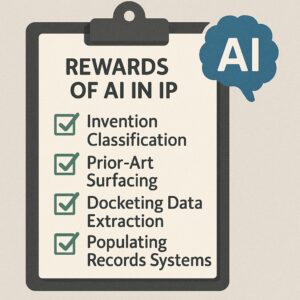
Yes. Patent offices are already introducing AI to assist with searching. This includes classifying inventions by technology, routing them to specialists, and surfacing similar prior art documents as a starting point.
There are also commercial AI-assisted search tools which can be used to help locate documents based on user prompts. Even general tools like ChatGPT, Claude, and Gemini can sometimes help.
As always with generative AI in patents, two big concerns are confidentiality and accuracy. There can be a real risk in inputting confidential invention details into an AI tool. If confidentiality is lost, a later patent application could be invalid. There is also a risk of AI suggesting prior art “results” that do not exist, and missing very relevant art.
AI can be used alongside human searching. If it can be done safely – and if it happens to find multiple relevant results – it may be useful, but humans should stay in the loop. For more on free tools (including PQAI, a patent searching tool which uses AI), see our blog on free online searching. The European Patent Office (EPO) also publishes information on how it is using AI in search.
Can AI speed up the patent drafting process?
Yes, it can. However, used incorrectly it can take longer and produce much worse applications than an experienced human can draft. One reason is that AI creates plausible-sounding content. Non-specialists may think it is suitable, but on inspection it can have serious flaws.
Because AI produces text quickly – and will likely keep improving – there may be a time when it reduces the time needed to draft a reasonable application. Even then though, experienced patent experts will be essential in the review process. In patents, a single incorrect word can take an application from potentially very valuable to worthless.
Can AI support freedom-to-operate (FTO) analysis?
In principle, yes. In practice, this is a very high-risk area for generative AI. It might help suggest work-arounds or design-arounds. It might help find prior art to challenge a patent. It might even help outline validity arguments. But relying on it without human input is extremely risky, given the consequences of an incorrect decision around FTO. There are many subtleties in assessing the scope of patents, even for experienced practitioners. Heavy reliance on AI for FTO seems very risky.
Can AI help with IP portfolio management?
Yes, and it is already being used. One example is docketing: extracting key details from patent office correspondence, and populating record systems. Best practice is still to keep a human check in the loop, but AI may save some time.
There are active discussions about using AI to help decide which patents in a large portfolio to renew or let lapse, and to support strategic decisions. As ever, over-reliance is risky. AI can get things wrong and may not understand the nuances of a business.
Does AI help with translating patents into multiple languages?
Machine translation has been used in patents for decades. Because patents are international, we often need translations to understand documents published in languages we do not speak. Patents may also need to be translated for filing in other countries.
However, language in patents is critical. Every word matters. Using generative AI to produce translations without human review is high risk. Subtle errors can make a patent worthless. For situations where only a general understanding is needed, a machine translation may be acceptable – but this should be assessed on a case-by-case basis.

What are the risks of using AI in patent drafting?
The main risk is unintentional disclosure of confidential information. Under most patent laws, it is critical to keep an invention confidential at least until after filing (some limited exceptions exist). If confidential details are input to an AI drafting tool and not kept confidential, a later-filed patent application for that invention might be invalid.
There are also data-handling risks. Even if a provider keeps data confidential, who can access it, and for what?
Another major risk is hallucinations and omissions. As patent attorneys, we check technical information carefully and decide what to include or exclude in a patent specification, and why. With AI, it is hard to know what was left out and on what basis.
A further risk is a false sense of security. AI can generate large volumes of legal-sounding, technically accurate, grammatically perfect text. Having reviewed many AI-generated patent drafts myself, quality varies widely. Sometimes it’s a usable starting point (with lots of work still needed). Sometimes it’s so far off that it’s quicker to start again. Non-experts can be misled into thinking they have a decent AI-generated patent specification when they do not.
How do you check an AI’s work for accuracy?
We do not assume it is correct. We treat it like work from a trainee that needs very careful review. With a human trainee, you learn their strengths and weaknesses and can ask how confident they are. With AI, each run can be different.
Because AI text reads smoothly, there is a temptation to trust it. Resist that. Force yourself to verify facts and logic. The key is to assume nothing and check as you would under normal, rigorous review.
Can confidential information be exposed when AI tools are used?
Yes. Some free or public tools state they may, or even will, use inputs to train and improve their models. Enterprise or private tools can reduce this risk, but you must still examine data retention and access policies. Some providers offer zero data retention (ZDR) options.
This is arguably the most important consideration when using AI in patent work. Getting it wrong can be catastrophic.
Are there liability issues if AI gets something wrong?
Yes. As regulated patent attorneys, we are responsible for our work products – whether it involves trainees, consultants, or AI. We cannot pass blame to a tool. We also follow strict professional and ethical guidelines, including telling clients if we plan to use generative AI in their work.
Can generative AI miss important content?
Absolutely. In experiments, this happens a lot. You can even ask an AI to confirm it captured everything and it may still miss items. Simple keyword checks often reveal gaps. This is another reason to keep humans in the loop.
Can AI lower professional standards in IP?
There is a risk. Not all IP service providers are regulated. Some may use AI to produce outputs that superficially look good, but that fall short in practice. Regulated patent attorneys must meet high professional standards regardless of the tools used.
This is why regulated patent attorneys have taken a cautious approach to AI. At Russell IP, we believe generative AI can be very helpful when used correctly, in the right circumstances, and with clients who understand the risks and rewards.
Conclusion
AI in IP is a fast-moving and evolving area. IP practitioners are still working out how best to maximise the benefits AI can bring while managing the risks.
Come back for future editions of AI in IP, where we will explore these and other questions in greater depth.
In the meantime, if you are interested in using AI in your IP work or protecting AI-related inventions with patents, contact Russell IP today for a free, no-obligation discussion.
Disclaimer
This article is general information, not legal advice. For tailored guidance, please contact Russell IP.