
By Iain Russell, UK and European Patent Attorney and Director at Russell IP (BSc, CPA, EPA, FRSA — 20 years’ experience in computer-implemented inventions and music technology).
What Is A Divisional Patent Application? A Guide For UK And European Patent Applications
Published: July 2026 | Last updated: July 2026
If you are a founder, inventor, or part of an early-stage team, you may come across the term divisional patent application while building your patent portfolio. A divisional patent application is a separate application that is split out from one you have already filed, and it can be a useful tool for shaping how an invention is protected.
Divisional applications are often misunderstood. They do not give you a longer patent term, and they cannot add anything new to what you originally filed. What they can do is give you flexibility: a way to pursue different claims, to keep an application alive at the patent office, or to separate out inventions that were bundled together in a single filing.
This guide explains how divisional applications work under UK and European patent law, where the rules differ, and why timing and cost matter. We also explain how the US uses similar terms in a slightly different way, which is a common source of confusion.
In this post, we’ll explain:
- what a divisional patent application is, and what it can and cannot contain;
- why a divisional is accorded the parent’s filing date, and how that differs from the priority date;
- when you can file a divisional in the UK and at the EPO;
- the costs and trade-offs involved; and
- how divisional applications differ in the US.
Key Takeaways
- A divisional patent application is split from an existing “parent” application and cannot contain any new technical subject matter beyond what the parent disclosed.
- A validly filed divisional is accorded the parent’s filing date, which is the date used to assess most prior art, but it may not automatically have the parent’s priority date for every part of the subject matter.
- In the UK and at the EPO, a divisional can generally only be filed while the parent is pending and UK divisionals may need to be prosecuted quickly.
- A divisional does not extend the term of protection; it shares the parent’s term, so it provides a different, additional scope of protection rather than extending the duration.
- Divisional strategy is one part of a wider patent strategy, and not every application needs one.
This article is a general guide to divisional patent applications. It is not legal advice. Every invention and patent strategy is different. If you need advice on your specific situation, please contact Russell IP to discuss your circumstances.
Contents
- What is a divisional patent application?
- What can a divisional application contain?
- Why is a divisional accorded the parent’s filing date?
- Filing date versus priority date
- When can you file a divisional patent application?
- Divisional timing in the UK
- Divisional timing at the EPO
- Does a divisional application extend the patent term?
- Why might you file a divisional application?
- How much do divisional applications cost?
- How are US divisional applications different?
- How do divisionals fit into patent strategy?
- Conclusion
- Frequently Asked Questions
What Is A Divisional Patent Application?
A divisional patent application is a new patent application that is divided out from an earlier application, known as the parent. It cannot go beyond what the parent already disclosed, but it can pursue different claims. In the UK and Europe, a divisional keeps the parent’s filing date, so is treated, for many purposes, as though it were filed on the same day as the parent.
What changes is what you are trying to claim. A divisional can be directed to a different aspect of the same invention, or to a separate invention that was described in the parent. The description, abstract and drawings often stay substantially the same; the claims are where the main differences tend to lie.
The rules governing divisional applications are set out in national and regional law, such as section 15 of the Patents Act 1977 in the UK and Article 76 of the European Patent Convention (EPC) administered by the EPO.
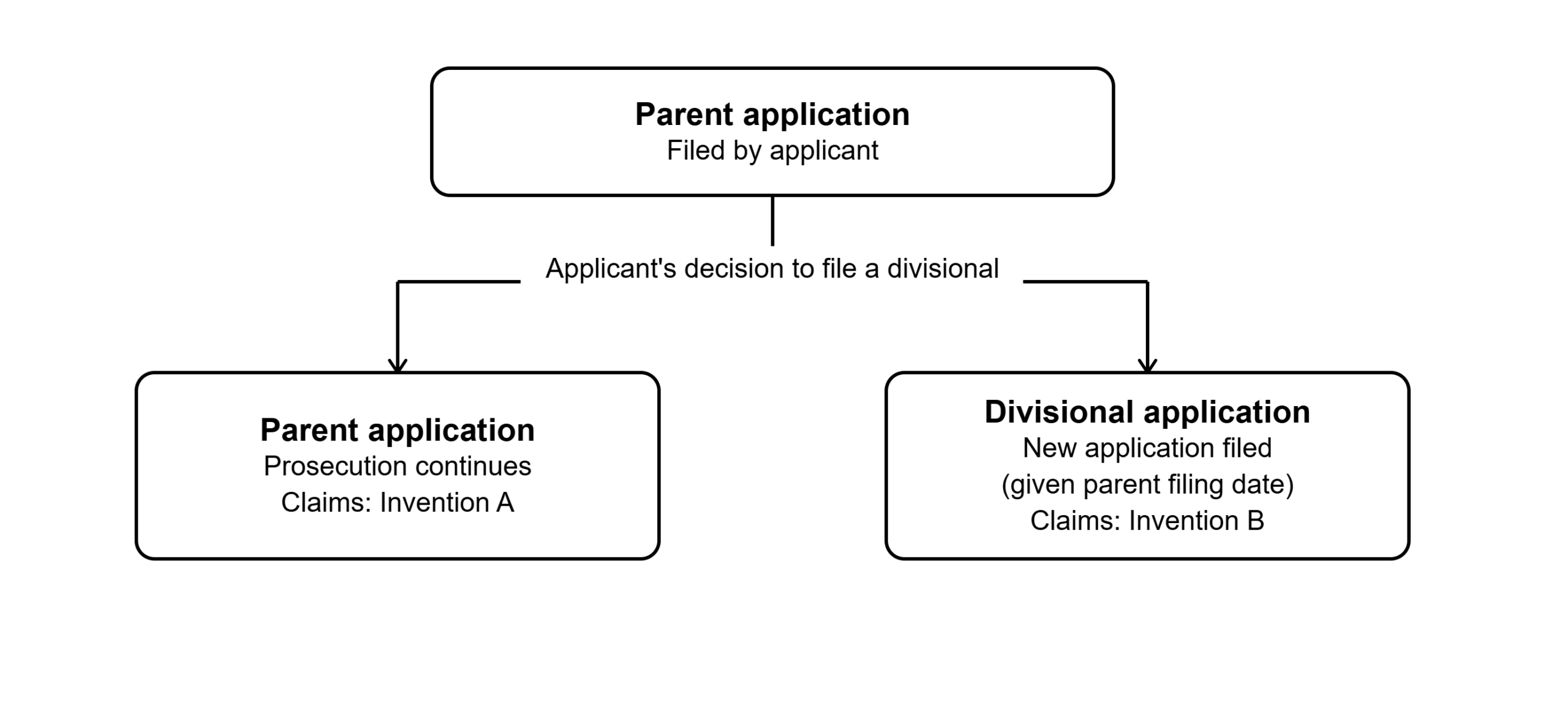
Flowchart showing a parent patent application giving rise to a divisional patent application, with both sharing the same filing date but with claims directed to different inventions.
What Can A Divisional Application Contain?
A divisional application can contain different claims from the parent, but it cannot contain new technical subject matter. Its description must stay within what the parent disclosed. This is why divisionals are typically used to pursue broader, narrower, or differently focused claims rather than to introduce anything new.
The claims in a divisional can differ from the parent in several ways. For example, a divisional’s claims might:
- be broader or narrower than the parent’s claims;
- be directed to a different part of an overall system or product;
- focus on an invention that had to be removed from the parent because the patent office decided the parent covered more than one invention; or
- approach the same invention from a different angle.
The key limit is that the content of a divisional cannot extend beyond the parent. You cannot use a divisional to add new technical detail, new examples, or improvements you thought of later. If you need to protect something genuinely new, that usually calls for a fresh application rather than a divisional.
Why Is A Divisional Accorded The Parent’s Filing Date?
A validly filed divisional is accorded the parent’s filing date because its content cannot go beyond what the parent disclosed. The filing date is the date against which most prior art is assessed. Without the parent’s earlier date, a divisional would be exposed to more prior art, which could undermine its validity.
If a divisional were treated as filed on the day it was actually submitted, rather than on the parent’s date, it could face years of extra prior art. Being accorded the parent’s filing date avoids that problem, provided the divisional stays within the parent’s disclosure.
Filing Date Versus Priority Date
A validly filed divisional is accorded the parent’s filing date, but it is not automatically entitled to every priority date the parent claimed. Priority can only be claimed for subject matter that was actually disclosed in the earlier priority document. If part of the invention was not in that document, the divisional generally cannot rely on the priority date for that part.
For example, suppose:
- a priority application discloses inventions A and B;
- a later application (the parent) discloses inventions A, B, and C; and
- the parent is then restricted to claims covering invention A only.
The parent’s claims to A would usually be entitled to the priority date of the first application, because A was disclosed there. Now suppose you file a divisional directed to invention C. Because C was only added in the parent, and was not in the original priority application, the divisional generally cannot rely on that earlier priority date for invention C, even though the parent can still rely on it for invention A.
| Invention | In the priority application? | In the parent application? | Earlier priority date available? |
|---|---|---|---|
| A | Yes | Yes | Yes |
| B | Yes | Yes | Yes, if claimed |
| C | No | Yes | No — only the parent’s filing date applies |
Note: This is a simplified illustration. Whether priority is validly claimed depends on the specific disclosures and the wording of the documents, and the rules can be technical. We can advise on priority entitlement for a particular case.
When Can You File A Divisional Patent Application?
In the UK and at the European Patent Office (EPO), a divisional can generally only be filed while the parent application is pending, i.e. when the parent is not granted. Some patent systems add further timing restrictions, so the deadlines need watching carefully.
Once a parent application grants, the window for filing a divisional from it usually closes. Because of this, the timing of a divisional is tied to the progress of the parent, which can be hard to predict. Missing the deadline can mean losing the opportunity to file at all, so it pays to plan ahead.
Divisional Timing In The UK
Under the UK system, a divisional filed close to the parent’s grant may have only a short time — sometimes just a few months — for prosecution to be completed and the divisional to be in order for grant.
By prosecution, we mean the back-and-forth with the patent office as an application is examined. A UK divisional generally has to be brought into a grantable state within the unextended compliance period of the parent. If the divisional is filed late in that period, the time left to deal with examination can be very short.
Planning the timing in advance is therefore an important part of a UK divisional strategy. For more on speeding things up at the UK IPO, see our guide on accelerating UK patent prosecution. You can also read the UK Intellectual Property Office’s official guidance via GOV.UK.
Divisional Timing At The EPO
At the EPO, there is no equivalent limit on how long a divisional can remain pending. A European application might be close to grant a few years after filing, yet a divisional filed before grant could itself stay pending for years afterwards.
A divisional can even become the parent of a further divisional, and that one can remain pending long after the original parent has granted. Divisional filings can therefore be used to keep an application alive at the EPO for an extended period. We look at why that flexibility can be valuable in the next section.
Does A Divisional Application Extend The Patent Term?
No. A divisional shares the parent’s filing date, so in almost all cases it has the same patent term as the parent — generally up to 20 years from that filing date. A divisional provides a different, additional scope of protection rather than changing its length.
Because a divisional is treated as filed on the parent’s date, it expires at broadly the same time as the parent would. Filing a divisional is therefore not a way to extend how long your protection lasts. What it can do is allow you to pursue broader, narrower, or refocused protection for subject matter in the parent application, for the same term.
Why Might You File A Divisional Application?
You might file a divisional to pursue claims that did not fit in the parent, to separate out a second invention, or to keep an application pending so you retain flexibility. A pending application can be amended more freely than a granted patent, whose scope is typically fixed once granted.
Common reasons to consider a divisional include:
- pursuing a different scope of claim (broader, narrower, or aimed at a different part of the subject matter of the parent);
- protecting a second invention that had to be removed from the parent;
- keeping an application pending at the patent office, which preserves the ability to adjust the claims as your technology or the market develops; and
- responding to a competitor by tailoring claims to what they are doing, while the application is still flexible.
Trade-Offs To Weigh Up
The main trade-off is flexibility against cost. A divisional keeps your options open, but it brings additional filing, prosecution, and renewal costs — and it does not extend your overall term. Whether it is worthwhile depends on the commercial value of the claimable subject matter and your wider strategy.
| Potential benefits | Potential drawbacks |
|---|---|
| Keeps an application pending, preserving flexibility to amend claims | Adds filing, prosecution, and renewal costs |
| Lets you pursue different or additional claim scope | Does not extend the term of protection |
| Can protect a second invention from the same disclosure | UK divisionals may need fast prosecution if filed late |
| Useful for responding to competitors over time | Later generations of divisional can attract higher official fees |
There is no single right answer here. We can help you weigh these factors for your situation.
How Much Do Divisional Applications Cost?
Pursuing a divisional application incurs costs including official filing fees, the professional time to prepare and prosecute the divisional, and renewal fees (which may be due before grant, for example for European divisionals).
Because the description and drawings are usually close to those of the parent, preparing a divisional often costs less than the original application, as the divisional reuses much of that material. The main effort is usually in preparing new claims, which still takes time and care but is typically less than starting from scratch.
Some patent systems charge higher official fees as the generation of divisional increases. At the EPO, for example, a second-generation divisional (a divisional of a divisional) can attract higher fees than a first-generation one, and this can continue for later generations. For grandchild filings and beyond, the added cost is a further commercial factor to weigh.
Official fees change over time, so current figures should always be checked with the relevant office. For ways to keep European costs down, see our guide on reducing European patent costs, or learn more about our services.
How Are US Divisional Applications Different?
US divisional applications are not the same as UK and European ones. In the US, the umbrella term “continuing application” refers to different ways of filing a further application based on a parent, including continuation applications, continuation-in-part applications and divisional applications:
- A US continuation can be directed to broadly any subject matter supported by the parent’s disclosure. This makes it similar in spirit to a UK or European divisional.
- A US divisional, by contrast, generally arises when the examiner issues a restriction requirement — an objection that the application covers more than one invention — and the applicant pursues a non-elected invention in the divisional.
- A US continuation-in-part allows additional subject matter (beyond what was disclosed in the parent) to be included.
In the UK and Europe, there is no need for the examiner to have objected that the application covers more than one invention before you can file a divisional.
| Feature | UK and Europe | United States |
|---|---|---|
| General term for a “child” application | Divisional application | Continuing application (includes continuation, continuation-in-part and divisional) |
| Closest equivalent to a UK or European divisional | Divisional application | Continuation application |
| Requires an examiner objection about multiple inventions? | No | A US divisional generally follows a restriction requirement |
| Can it add new technical matter? | No | No (a separate “continuation-in-part” route exists for new matter) |
How Do Divisionals Fit Into Patent Strategy?
Divisional applications are one tool within a broader patent strategy, not a default step. Many applications never have a divisional filed. The value of a divisional depends on the subject matter, your commercial goals, and the timing of the parent.
What matters is knowing the option exists, understanding when it can be used, and factoring it into your plans early. Because the filing window is tied to the parent’s progress and, in the UK, the prosecution window can close quickly, decisions are often best made well before they become urgent.
If you are building a portfolio around AI, software, telecommunications, or music technology, divisional strategy can sit alongside decisions about where to file, what to claim, and how to manage cost. Closely related choices, such as how priority works, are covered in our guide on provisional patent applications. We can help you think these through as part of an overall plan.
Conclusion
A divisional patent application lets you carve a separate application out of one you have already filed, keeping the parent’s filing date while pursuing different claims. It does not add new subject matter and does not extend your patent term. What it offers is flexibility and the ability to shape protection over time.
There are trade-offs to filing divisional applications: extra cost, careful timing, and — in the UK — the possibility of a short prosecution window. Whether a divisional is right for you depends on the value of the claimable subject matter and your wider strategy, and the impact of the differing rules between the UK, Europe, and the US on your particular circumstances.
If you are weighing up a divisional patent application or need help with your patent strategy, contact Russell IP today for a free, no-obligation discussion.
Disclaimer: This article is general information, not legal advice. For tailored guidance, please contact Russell IP.
Frequently Asked Questions About Divisional Patent Applications
What is a divisional patent application?
A divisional patent application is a separate application split out from an earlier “parent” application that cannot contain any new technical subject matter beyond the parent’s disclosure. If validly filed, a divisional keeps the parent’s filing date. A divisional is typically used to pursue different claims. At Russell IP, we use divisionals to help clients refine or expand how an invention is protected.
Does a divisional application keep the same filing date as the parent?
Yes, in most cases. A divisional is accorded the parent’s filing date, which is the date used to assess most prior art. This is one of its main benefits, because an earlier date means less prior art can be used against it. The divisional must stay within what the parent disclosed to keep that date.
Does a divisional application get the same priority date as the parent?
Not necessarily. A divisional can only claim a priority date for subject matter that was actually disclosed in the earlier priority document. If part of the invention was added later in the parent, the divisional generally cannot rely on the earlier priority date for that part, even if the parent can for other parts.
When can you file a divisional patent application in the UK?
In the UK, a divisional patent application can generally only be filed while the parent is pending — when it is not granted. If filed close to grant, a UK divisional may have only a few months to be put in order for grant, so the timing needs careful planning. Russell IP can help you track these deadlines.
Does filing a divisional patent application extend how long my patent lasts?
No. A divisional shares the parent’s filing date, so it has the same term — generally up to 20 years from that date. A divisional provides a different scope of protection within that term rather than extending its length.
How much does a divisional patent application cost?
It depends on the invention and the patent office, but a divisional often costs less than the original application because the description and drawings are usually substantially reused. You should still budget for official fees (including renewal fees) and the time to prepare new claims. Some offices, including the EPO, charge higher fees for later generations of divisional. Get in touch with Russell IP for an estimate.
Are US divisional applications the same as UK ones?
No. In the US, a divisional specifically follows a “restriction requirement” from the examiner, whereas the closest equivalent to a UK or European divisional is usually a US continuation application. In the UK and Europe, no examiner objection about multiple inventions is needed before filing a divisional.
Can Russell IP help with divisional patent applications?
Yes. Russell IP is a UK firm of patent attorneys that advises on divisional patent applications as part of UK, European, and wider patent strategy, particularly for technology inventions in areas such as AI, software, telecommunications, and music technology. Get in touch with Russell IP to discuss your situation.