
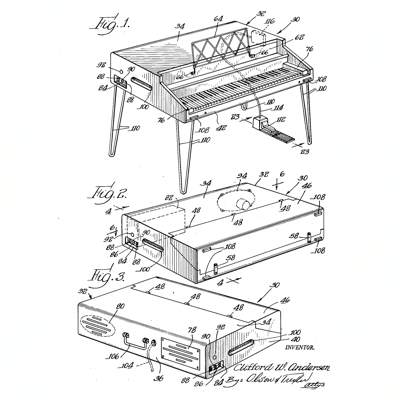
- Rockin’ Patent®: US Patent No. 2,974,555
- Filed: 18 March 1955
- In the name of: Wurlitzer Co
- Title: Electronic Piano
- What’s claimed: “An electronic musical instrument comprising a common reed support, a plurality of reeds with bases fixed on said common support and with vibratile tongues projecting in the same direction therefrom in side-by-side substantially coplanar parallelism from said support, a plurality of hammers respectively percussively engageable with the tongues of said reeds respectively to set said reed tongues in decadent free vibration, a plurality of manually engageable keys respectively operatively connected to said hammers for selectively moving said hammers into such percussive engagement with said reed tongues, a sheet metal pickup member of fiat uniform thickness comb-like configuration having a plurality of parallel teeth and an intermediate plurality of slots each opening at one end, means mounting said pickup member in opposition to said reeds substantially in a common plane therewith with the reeds projecting into the slots between the teeth, the teeth on opposite sides of a reed extending substantially the same distance therealong, there being at least one reed tongue in each slot, and each reed being closely adjacent a pickup tooth along a longitudinal edge of said reed, said pickup teeth terminating at free ends short of the reed bases, the hammers respectively percussively engaging the reed tongues between the reed bases and the free ends of the adjacent pickup teeth, said reeds and said pickup member comprising electrostatic tone generating means, means establishing an electrical potential between said reeds and said pickup member, electric oscillations being generated in accordance with the change in capacity between said reeds and said pickup member resulting from free decadent vibration of said reeds relative to said pickup member, electronic amplifying means connected to said reeds and said pickup member for amplifying the oscillations generated by the decadent free vibration of said reed tongues, and electroacoustic translating means connected to said amplifying means for converting the amplified oscillations into audible tones.”
- Why this patent rocks: This patent relates to the Wurlitzer electric piano that uses flat metal reeds, as opposed to tines used in most other electronic pianos. These reeds vary in length to match the desired pitch or note and vibrate when struck with the piano hammer tips. This vibration is converted into an electric signal once picked up by the electrostatic pickup system. The Wurlitzer is described as giving a 60s-70s pop/rock/soul sound and has been used by Ray Charles, Supertramp, and many more. For a more detailed take on how the Wurlitzer works, see here.
If you’re a patent-savvy music tech business looking for patent help, get in touch with Russell IP here!
The information above is for general interest and information only and does not constitute legal advice.