
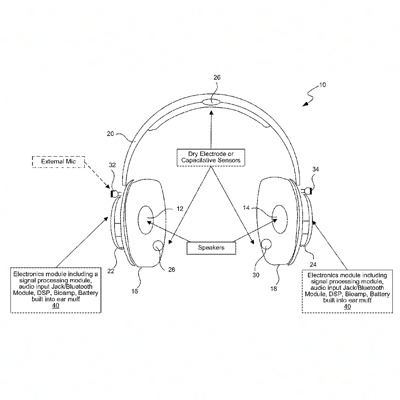
- Rockin’ Patent®: US Patent No. 9,497,530
- Filed: 13 May 2016
- In the name of: Nura Holdings Pty Ltd
- Title: Personalization Of Auditory Stimulus
- What’s claimed: “Headphones configured to personalize an audio signal to a user, the headphones comprising: a speaker proximate to a user’s ear, configured to emit a content audio signal and a test audio signal, the test audio signal comprising a frequency in the audible frequency range; a microphone proximate to the user’s ear, the microphone configured to measure a response associated with the user, the response comprising a sound evoked in the user’s ear in response to the test audio signal; a processor, coupled to the speaker and to the microphone, the processor configured to: generate the test audio signal; send the test audio signal to the speaker; receive from the microphone the response to the test audio signal associated with the user; based on the test audio signal and the response to the test audio signal, determine a hearing transfer function associated with the user; identify the user based on the response associated with the user, the response comprising the sound evoked in the user’s ear in response to the test audio signal; receive a statistical information representing data regarding human hearing profiles; based on the hearing transfer function associated with the user and the statistical information representing data regarding human hearing profiles, adjust an amplitude associated with the content audio signal to automatically compensate for a difference between a desired hearing transfer function and the hearing transfer function associated with the user; and send the adjusted content audio signal to the speaker.”
- Why this patent rocks: This patent appears to relate to Nura Holdings Pty Ltd’s ‘Nuraphone’ headphones. Inside the ear cups are a pair of earbuds that sit in the top part of the ear canal, these play high mids and treble while mids and bass notes are reproduced by a large driver in the main body of the ear cup. The assignees claim that the headphones automatically learn and adapt to users’ hearing using small, sensitive microphones embedded inside each earcup, detecting the user’s response to the audio signal. This signal is then modified to achieve desired hearing. If you’re curious to learn more about the mechanics, see here. For more general information, see here.
If you’re a patent-savvy music tech business looking for patent help, get in touch with Russell IP here!
The information above is for general interest and information only and does not constitute legal advice.