
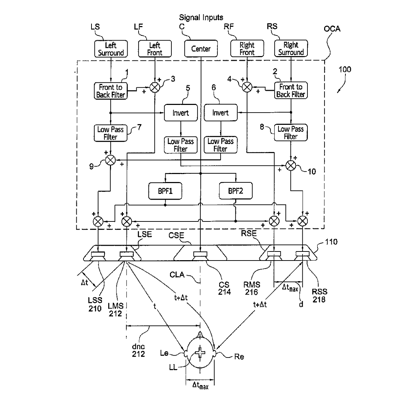
- Rockin’ Patent®: US Patent No. 9,374,640
- Filed: 8 December 2014
- In the name of: Bradley M Starobin
- Title: Method And System For Optimizing Center Channel Performance In A Single Enclosure Multi-element Loudspeaker Line Array
- What’s claimed: “A single enclosure multi-element loudspeaker line array audio reproduction system configured to provide enhanced Center Channel Performance, comprising: (a) an audio reproduction system comprising: a first audio input signal, a second audio input signal, a third audio input signal, a fourth audio input signal and a fifth (center channel) audio input signal; (b) a left main speaker and a right main speaker disposed respectively at left and right main speaker locations spaced along a speaker array axis defined as a line passing through said left and right main speaker locations, with a listening area comprising the general area in front of the left and right main speaker locations such that the left main speaker location lies to the left and the right main speaker location lies to the right when viewed from the listening area, wherein said left and right main speakers reproduce sound associated with signals received by said left and right main speakers; a left sub-speaker and a right sub-speaker disposed respectively at left and right sub-speaker locations, wherein the left and right sub-speaker locations lie approximately on the speaker axis such that the left and right sub-speaker locations as viewed from the listening area are located to the left and right respectively of the respective left and right main speaker locations; (c) a center front speaker located between the left and right main speaker locations at a midpoint of said speaker array axis, wherein said center front speaker reproduces sound associated with signals received by it; and means for transmitting said fifth audio input signal to said center front speaker; wherein sound reproduced by the system associated with said fifth audio input signal is perceived by a listener located in the listening area whose head is oriented generally toward the speaker locations to originate from approximately the location of said center front speaker; (d) signal modification and combination means, wherein said signal modification and combination means comprises, means for modifying the first audio input signal and combining the modified first audio input signal with the second audio input signal and transmitting the combination of said modified first audio input signal and said second audio input signal to said left main speaker, means for modifying the fourth audio input signal and combining the modified fourth audio input signal with the third audio input signal and transmitting the combination of said modified fourth audio input signal and said third audio input signal to said right main speaker, means for subtracting said modified fourth audio input signal from said modified first audio input signal and transmitting the resulting difference signal to said left sub-speaker, and means for subtracting said modified first audio input signal from said modified fourth audio input signal and transmitting the resulting difference signal to said right sub-speaker, wherein sound reproduced by the system that is associated with said second and third audio input signals is perceived by a listener located in the listening area whose head is oriented generally toward the speaker locations to originate from a range of sound locations approximately between said left and right main speakers; and (e) wherein said signal modification and combination means further includes first bandpass filter means for modifying the fifth (center channel) audio input signal and transmitting the modified fifth (center channel) audio input signal to said left and right sub speakers, and wherein said signal modification and combination means further includes second bandpass filter means for modifying the fifth (center channel) audio input signal and transmitting the modified fifth (center channel) audio input signal to said left and right main speakers; wherein the reproduced sound associated with said fifth (center channel) audio input signal when reproduced by said left and right sub speakers said left and right main speakers and said center front speaker is perceived by a listener located in the listening area whose head is oriented generally toward the speaker locations to originate from a sound location near said midpoint of said speaker array axis.”
- Why this patent rocks: This patent appears to relate to Polk Audio’s Voice Adjust technology, used in their products such as their Polk MagniFi Mini AX soundbar. Polk Audio suggests that the technology improves the clarity of dialogue or voice in soundtracks. For more information, see here.
If you’re a patent-savvy music tech business looking for patent help, get in touch with Russell IP here!
The information above is for general interest and information only and does not constitute legal advice.