
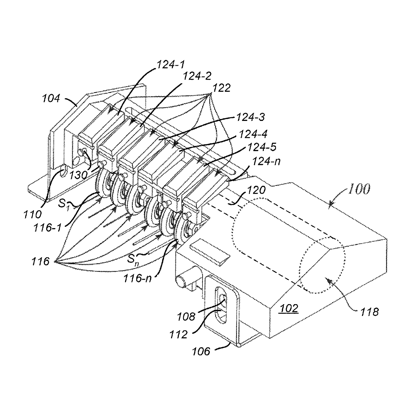
- Rockin’ Patent®: US Patent No. 9,997,144
- Filed: 10 July 2015
- In the name of: Aaron H Kipness (inventor)
- Title: Attachment Device For Stringed Instrument And Coupling System For Use With The Same
- What’s claimed: “An attachment for use with a stringed musical instrument, comprising a rotatable shaft; at least one group of one or more string engaging elements coupled to the rotatable shaft, each string engaging element of a group being positionable in a first orientation for driven rotary engagement with a corresponding string of the musical instrument and in a second orientation; and at least one key actuator operatively associated with each group of one or more string engaging elements, the at least one key actuator being manipulable so as to urge each string engaging element of a group into at least one of the first orientation or the second orientation, wherein the at least one key actuator is manipulable into an actuated position for urging a first string engaging element into the first orientation for rotation at a first speed, when an adjacent string of the musical instrument is not bent, and for urging the first string engaging element into the second orientation for rotation at a second speed when the adjacent string of the musical instrument is bent in a direction toward the first string engaging element, and whereby a speed at which the first string engaging element rotates is determined by both a speed at which the rotatable shaft rotates and a degree to which the adjacent string is urged into contact with the first string engaging element.”
- Why this patent rocks: This patent appears to relate to the ‘Gizmotron 2.0’, a mechanical bowing device that attaches to electric guitar or bass, allowing users to produce string sounds such as cello, viola or violin. On their website, Gizmotron outlines the history of the device: it was originally invented in the mid-1970’s by Lol Crème and Kevin Godley of 10cc but was a ‘commercial failure’. The device was redeveloped by the inventor Aaron Kipness and resulted in the Gizmotron 2.0.
If you’re a patent-savvy music tech business looking for patent help, get in touch with Russell IP here!
The information above is for general interest and information only and does not constitute legal advice.