
By Iain Russell, Patent Attorney and Director at Russell IP (BSc, CPA, EPA, FRSA – 20 years’ experience in computer-implemented inventions and music technology).
What Does A New UK Government Study Reveal About AI Patents?
Published: September 2026 | Last updated: September 2026
A recent government-backed study in the UK has found that AI-related patent applications rose from 5.2% of all US patent applications filed in 2014 to 20.3% in 2023. In other words, AI patent applications now make up roughly one in five filings in the US.
The finding comes from a study called AI Skills for Life and Work: Patent analysis, published by the UK Department for Science, Innovation & Technology (DSIT) and the Department for Culture, Media & Sport (DCMS), and authored by researchers at the Warwick Institute for Employment Research in the UK.
The study is primarily focused on the labour market and associated skills. It uses United States Patent and Trademark Office (USPTO) data from 2014 to 2023 as an early indicator of the AI knowledge the economy is likely to increasingly need. Its findings do not represent UK Government policy. Our aim here is simply to summarise the study’s main conclusions on AI patent activity and to note, briefly, what they may mean for innovators in the UK and elsewhere.
Below, we cover how much AI-related patent filings have grown, which technologies feature most, how widely AI now spreads across technical fields, and why the study’s emphasis on combining skills is relevant to protecting AI inventions.
Key Takeaways
- There is no single “AI” patent class. The study found AI activity spread broadly across around 450 patent classes and many fields, from surgery to vehicles to telecommunications.
- Patent applications increasingly combine several AI techniques, with the average rising from around two per application in 2014 to over three and a half by 2023.
- The study stresses combining core AI skills with sector-specific knowledge. In our experience, that dual understanding also matters when protecting AI inventions.
This article is a general summary of a UK government study on AI patent activity. It is not legal advice. Every invention and patent strategy is different. If you need advice on your specific situation, please contact Russell IP to discuss your circumstances.
Contents
- How much have AI patent filings grown?
- Which AI technologies feature most?
- Is AI concentrated in one area of technology?
- Why does combining skills matter?
- What else does the study highlight?
- Conclusion
- Frequently Asked Questions
How Much Have AI Patent Filings Grown?
AI-related patent applications grew from 5.2% of all US patent applications in 2014 to 20.3% in 2023, according to the study. Over the same period, AI-related applications grew by a factor of 3.8, from 18,500 in 2014 to 69,600 in 2023, and totalled around 438,000 across the decade.
The chart below, built from the study’s own figures, shows the year-by-year trend.
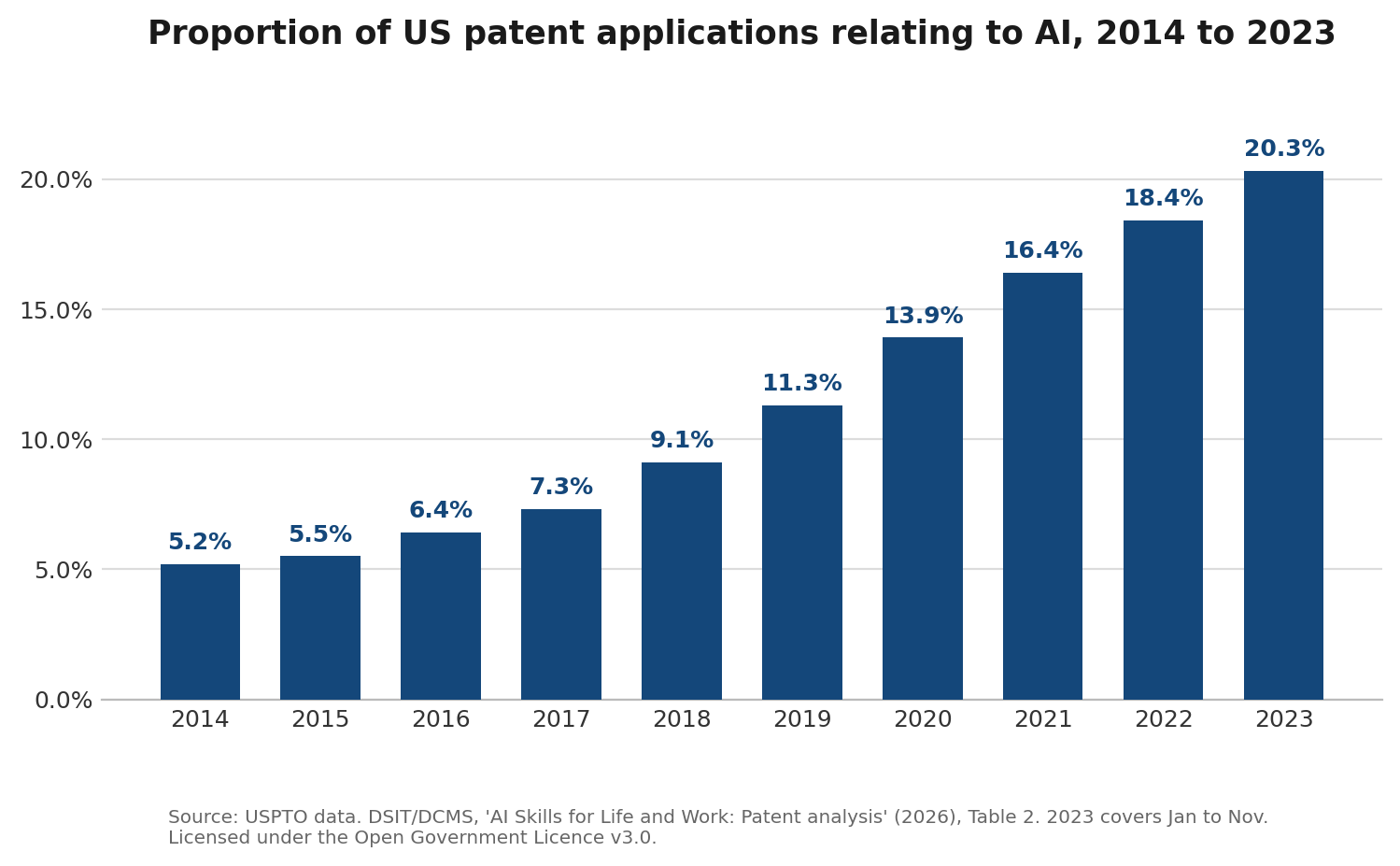
Bar chart showing AI-related patent applications as a proportion of all US patent applications, rising from 5.2% in 2014 to 20.3% in 2023, based on USPTO data from the DSIT/DCMS study.
Which AI Technologies Feature Most?
According to the study, the four most common technologies in both 2014 and 2023 were algorithms, artificial intelligence, neural networks, and machine learning.
Several other techniques rose sharply in relative importance during the period studied, including deep learning, generative adversarial networks (GANs), chatbots, recurrent neural networks (RNNs), and variational autoencoders (VAEs). Deep learning and GANs each climbed around 25 places in the rankings between 2014 and 2023.
Is AI Concentrated In One Area Of Technology?
No. The study found that AI-related activity was spread across around 450 patent classes and applied to a wide range of fields, from surgery and vehicles to telecommunications and chemistry.
Excluding design patents (which are directed to the visual appearance of an article), the USPTO patent examination corps is organised into eight primary Technology Centers (TCs), each concerned with a different broad technical category. The study identified concentrations of AI activity in five of those TCs:
- Computing models (Physics TC)
- Telecommunications (Electricity TC)
- Surgery, medical applications, and video games (Human necessities TC)
- Vehicles and manipulators (Performing operations and transporting TC)
- Measuring or testing processes (Chemistry TC).
Why Does Combining Skills Matter?
The study found that patent applications increasingly draw on several AI techniques at once, with the average number of technologies per patent application rising from around two in 2014 to over three and a half by 2023. It concludes that core AI skills increasingly need to be combined with sector-specific knowledge, describing these as different “packages” of knowledge for different fields.
In our experience, the same can be true when protecting AI inventions. Understanding the AI is often not enough on its own: understanding the field it is applied to – whether that is medical devices, telecommunications, or audio technology – can matter just as much when preparing a patent application. This is one reason we pair AI and machine learning expertise with knowledge of the sectors our clients work in. You can read more on our services page.
What Else Does The Study Highlight?
Two further observations from the study are worth noting.
First, the study treats patent applications as an early indicator, describing patent data as a bellwether for technologies likely to be adopted in the future. It shows that emerging techniques can be tracked from a very early stage: filings mentioning GANs rose from 12 in 2017 to 8,440 in 2023, and those mentioning VAEs rose from 1 to 2,011 over the same period.
Second, the study highlights how much change – or “churn” – there has been in which technologies are considered important. Deep learning and GANs rose sharply, while a few areas fell back, with data mining being a rare example of a technology declining in absolute terms.
Conclusion
On the USPTO data analysed, AI has grown from a small share of patenting to around one in five applications in under a decade, and it now reaches across a wide range of fields rather than sitting in any single category.
For innovators, the study’s most practical point is that AI is rarely a standalone technology. It is increasingly combined with other technical fields. As such, the need for both AI knowledge and domain expertise is becoming increasingly important, both in developing AI-related technologies and in protecting AI-related inventions.
If you are working on an AI or machine learning invention and would like to understand your options for patent protection, contact Russell IP today for a free, no-obligation discussion.
Source and licence: This post summarises AI Skills for Life and Work: Patent analysis (Department for Science, Innovation & Technology and Department for Culture, Media & Sport), © Crown copyright 2026, authored by the Warwick Institute for Employment Research. It contains public sector information licensed under the Open Government Licence v3.0. The full study is available on GOV.UK.
Disclaimer: This article is general information, not legal advice. For tailored guidance, please contact Russell IP.
Frequently Asked Questions About AI Patent Activity
What proportion of US patent applications are AI patent applications?
AI-related patent applications made up 20.3% of all US patent applications in 2023, up from 5.2% in 2014, according to the DSIT/DCMS study summarised here. The figures are based on USPTO patent data and reflect US patent applications where AI forms part or all of the subject matter.
Is there a single patent class for AI?
No. AI-related activity was spread across around 450 patent classes over 2014 to 2023, ranging from wholly AI-focused inventions to AI applied to other fields such as vehicles or surgery.
Does the study use UK patent data?
No. The study uses USPTO patent data from 2014 to 2023, chosen because of the volume and accessibility of that data. It is a UK government-backed skills study, but its findings do not represent UK government policy.
Which technologies are driving the growth in AI patent applications?
Deep learning, generative adversarial networks (GANs), chatbots, recurrent neural networks (RNNs), and variational autoencoders (VAEs) rose most sharply in the rankings between 2014 and 2023, according to the study. The four most common technologies throughout the period remained algorithms, artificial intelligence, neural networks, and machine learning.
Why does combining AI and sector knowledge matter for patent applications?
The study found that AI is increasingly combined with other technologies, so different fields require different “packages” of knowledge. In our experience at Russell IP, protecting AI inventions can likewise call for both AI expertise and knowledge of the field in which AI is applied.
Can Russell IP help with AI patent application?
Yes. Russell IP specialises in protecting technology innovations, including AI, machine learning, and computer-implemented inventions. This article is general information rather than legal advice, so please contact Russell IP to discuss your specific circumstances.