
- Rockin’ Patent®: South Korea Patent No. 10-2168529
- Filed: 29 May 2020
- In the name of: Supertone Inc
- Title: Method and apparatus for synthesizing singing voice with artificial neural network
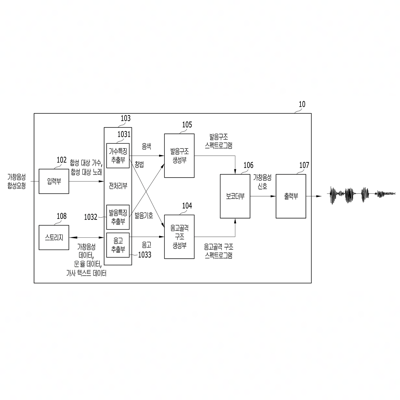
- What’s claimed (machine translation): ”In the singing-speech synthesis method using a song-speech synthesis device trained with a training data set, obtaining a song voice synthesis request including a synthesis target singer and a synthesis target song from a user; Acquiring song voice data of the synthesis target singer, prosody data, and lyrics text data of the song to be synthesized based on the song voice synthesis request; Based on the song voice data, the prosody data, and the lyrics text data, a tone feature vector representing the tone of the composite target singer, a window feature vector representing the windowing method of the composite target singer, and a pronunciation symbol of the composite target song. Extracting a phonetic symbol feature vector and a pitch feature vector representing the pitch of the song to be synthesized; Generating a pronunciation structure spectrogram representing pronunciation characteristics of the synthesized singer based on the tone feature vector and the phonetic symbol feature vector, by a pronunciation structure generation unit of the song-sound synthesis device-the pronunciation structure generation unit An artificial neural network trained in advance with tone feature vectors for a plurality of singers and phonetic feature vectors for a plurality of songs included in the training data set; A pitch skeleton structure spectrogram representing the pitch skeleton of the synthesized target song is generated based on the singing feature vector and the pitch feature vector based on the singing feature vector and the pitch feature vector. The pitch skeleton structure generation unit is an artificial neural network previously trained with the singing feature vectors for a plurality of singers and pitch feature vectors for a plurality of songs included in the learning data set; And generating a vocal voice signal for the synthesized target song expressed as the vocal voice of the synthesized singer based on the pronunciation structure spectrogram and the pitch skeletal structure spectrogram.”
- Why this patent rocks: This patent relates to technology by Supertone Inc that uses artificial intelligence to produce new songs by deceased artists. The AI bot is not limited by language, with Supertone Inc showcasing the bot singing in the voice of Freddie Mercury but in Korean. You can listen here.
If you’re a patent-savvy music tech business looking for patent help, get in touch with Russell IP here!
The information above is for general interest and information only and does not constitute legal advice.