
- Rockin’ Patent®: US Patent No. 8,017,858
- Filed: 6 June 2009
- In the name of: Steve Mann (inventor)
- Title: Acoustic, Hyperacoustic, Or Electrically Amplified Hydraulophones Or Multimedia Interfaces
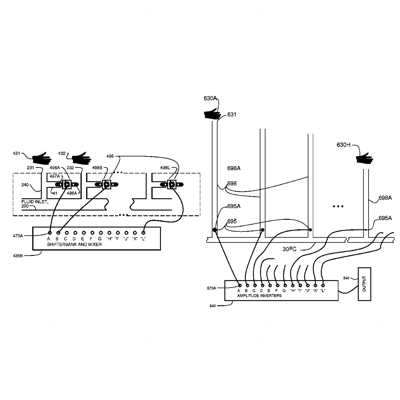
- What’s claimed: “An instrument, said instrument for being used with a plurality of pieces or containers or regions of user interface input fluid, said pieces or containers or regions of fluid for direct physical contact by a user of said instrument, said instrument comprising: a plurality of pickups, each arranged for conversion of one of (a) an acoustic disturbance, or (b) a vibrational disturbance, or (c) a pressure or flow disturbance in each of said pieces or containers or regions of input fluid; an electric circuit connected to an output of each of said pickups, said electric circuits each altering said disturbance into a signal comprising one note of a musical scale, with a one-to-one correspondence between said pieces or containers or regions of input fluid, and said notes of said musical scale; and one or more output devices for converting said signals into sound; said instrument further including a housing, a plurality of flow channels, each flow channel having an output adapted to permit the fluid to flow therefrom and be selectively obstructed by a user to reduce or alter the flow therefrom, wherein each pickup is positioned to sense the reduction or alteration in the flow therefrom, where each of said pickups is connected to one of the electric circuits, said instrument further including at least one audio output from said electric circuits, and each of said electric circuits including an amplitude inverter wherein the pickup receives a linearly varying signal that has a maximum amplitude value when the user is not in contact to the medium and a minimum amplitude value or off value when the user is fully interacting with the media and intermediate values there between and the amplitude inverter calculates an output value to produce an output signal that is inversely correlated to its input, and wherein the output signal of each amplitude inverter controls a musical note amplitude varying from an off or minimum level to a maximum level in correspondence to the output signal.”
- Why this patent rocks: This patent appears to relate to Steve Mann’s ‘Hydraulophone’; a tonal instrument that produces music by employing water power through a long tube. The tube has various holes that produce the sound when pumps force the water through the tube. If you’d like to hear it in action, see this video. If you’d like more information, see here.
If you’re a patent-savvy music tech business looking for patent help, get in touch with Russell IP here!
The information above is for general interest and information only and does not constitute legal advice.