
- Rockin’ Patent®: US Patent No. 7,157,633
- Filed: 2 March 2004
- In the name of: Richard Martin Kopesec
- Title: Simulated Stringed Instrument Practice Device
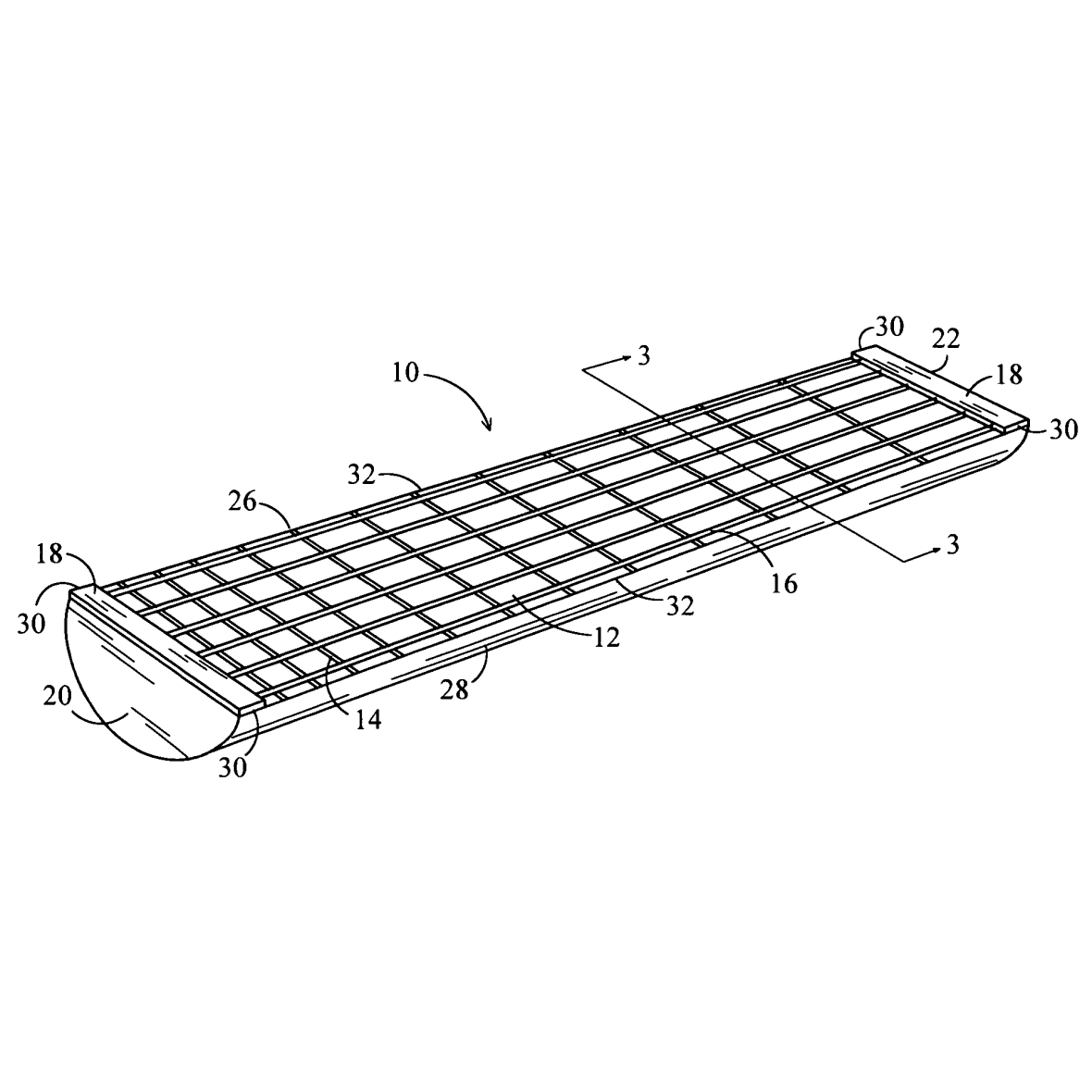
- What’s claimed: “A simulated stringed musical instrument practice device comprising: an elongated neck member defining proximal and distal ends, said neck member having a generally flat shaped upper surface which extends longitudinally from said proximal end to said distal end thereby defining lateral edges thereof which are generally perpendicular to said proximal and said distal ends, said elongated neck member also having a lower surface which extends substantially from said proximal end to said distal end, said lower surface having lateral edges which are attached to the lateral edges of said upper surface, wherein said lower surface is generally arcuate in shape in order to simulate the shape of a conventional stringed instrument; a plurality of longitudinally spaced, transversely extending ridges which are integrally attached to said flat upper surface, said transversely extending ridges are spaced progressively longer distances apart from said proximal end to said distal end, whereby said transversely extending ridges simulates the frets of a conventional stringed instrument; a plurality of longitudinal ridges which extend from said proximal end to said distal end over said flat upper surface, said longitudinal ridges are integrally attached to said flat upper surface, whereby said longitudinal ridges simulates the strings of said conventional stringed instrument; and a footing means which are attached to said flat upper surface for providing a non-slip support surface for the flat upper surface, thereby enabling the use of said simulated stringed musical instrument device as a conventional computer keyboard wrist rest”.
- Why this patent rocks: It relates to a stringed instrument practice device which may also be used as a computer keyboard wrist rest – so you can practice playing during your lunch break, for example.
- The patent describes the desire to be able to practice playing a stringed instrument: “[t]he art of playing a guitar or other stringed instrument is a learned skill that requires many hours of practice in order to master. However in many instances, periodic practice of the stringed instrument in various environments such as the workplace or during travel are limited due to the instrument’s large size as well as the relatively loud audible levels produced thereby. In addition, the intricate mechanisms common on most types of stringed instruments necessitates the need for special handling and storage means in order to insure no damage occurs during transportation. Guitars, mandolins, bass guitars, banjos, violins, cellos, contrabasses, and ukuleles comprise a list of stringed musical instruments which will hereinafter be referred to generally as “stringed instruments” due to their relatively similar structural design”.
- It also describes that “there has remained a long-felt need for a stringed instrument practice device which is inexpensive, maintenance free, and easily transportable for the practice thereof when access to a conventional stringed instrument is not feasible. In addition, the utility of a conventional computer keyboard wrist rest could be further enhanced via implementation of a simulated stringed instrument practice device thereinto”.
- The patent describes that it “provides a solution to the aforementioned needs as well as other needs via a simulated stringed instrument practice device which is low cost and easily transported thereby enabling its use at any location and in all types of environments. The present invention generally comprises an elongated section of material that is relatively similar in shape to the neck of a conventional stringed instrument. The elongated section of material has a generally flat surface fashioned thereon with raised projections simulating frets of a conventional guitar. The flat surface also has raised projections integrally attached thereon which extend substantially normal to the frets in order to simulate the strings of a conventional stringed instrument. This design creates a very robust structure having no actual strings or associated attachment mechanisms thereby requiring costly assembly or periodic maintenance during use. In addition, this novel, unobvious design enables manufacture of a stringed instrument practice device wherein the neck portion, frets, and simulated strings are integrally molded from one piece, thus minimizing manufacturing costs. Optionally, the present invention may provide novel, unobvious utility as a computer keyboard wrist rest. Non-slip footings are provided for attachment to the flat surface in order to provide for secure placement adjacent the keyboard of a computer in a similar manner to conventional wrist rests”.
If you’re a patent-savvy music tech business looking for patent help, get in touch with Russell IP here!
The information above is for general interest and information only and does not constitute legal advice.