
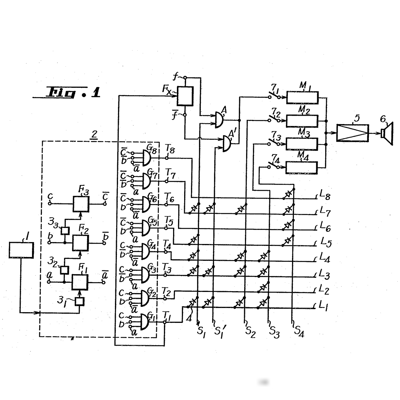
- Rockin’ Patent®: US Patent No. 3,482,027
- Filed: 27 April 1966
- In the name of: Nippon Columbia Co Ltd
- Title: Automatic Rhythm Instrument
- What’s claimed: “An automatic rhythm player for electronic musical instruments comprising a pulse oscillator producing pulse train having a period corresponding to a greatest common measure of minimum time duration of various rhythms; means for sequentially arranging at a plurality of output terminals the pulses from the pulse oscillator as pulse trains that are separated and phase-shifted from adjacent ones; a first group of conductors each being connected to each of the plurality of output terminals respectively, the spatially separated and phase-shifted pulse trains passing through the first group of conductors respectively; a second group of conductors each being arranged to cross the first group of conductors; a plurality of diodes for selectively connecting the conductors of the first group with selected ones of the second group in accordance with rhythms desired, thereby obtaining a pulse train corresponding to the rhythms required at each of said plurality of output terminals of the second group of conductors; a plurality of selector switches, a plurality of sound source circuits of electronically producing different tones actuated by the pulse train obtained from the second group of conductors through said selector switches, each of the selector switches inserted between the input side of each sound source circuit and each of the output terminals of the second group of conductors, an amplifier and a speaker common to the sound source circuits for making the outputs of the sound source circuits audible; and means for producing rhythms having a period several times that of a rhythm produced by the pulse trains from the second group of conductors, the last-mentioned means being actuated by two or more of the pulse trains from the second group of conductors and one of the pulse trains from the output terminal of the first-mentioned means, and the output of the last-mentioned means being supplied to one of the sound source circuits through said selector switches whereby a desired rhythm can be produced.”
- Why this patent rocks: This appears to be one of the many patents relating to early electronic drum machines. This automatic rhythm instrument was capable of electronically producing various rhythms in the ‘characteristic tones of a drum, a piccolo and so on.’ For a take on Nippon Columbia Co Ltd’s role in the history of drum machines, see here.
If you’re a patent-savvy music tech business looking for patent help, get in touch with Russell IP here!
The information above is for general interest and information only and does not constitute legal advice.