
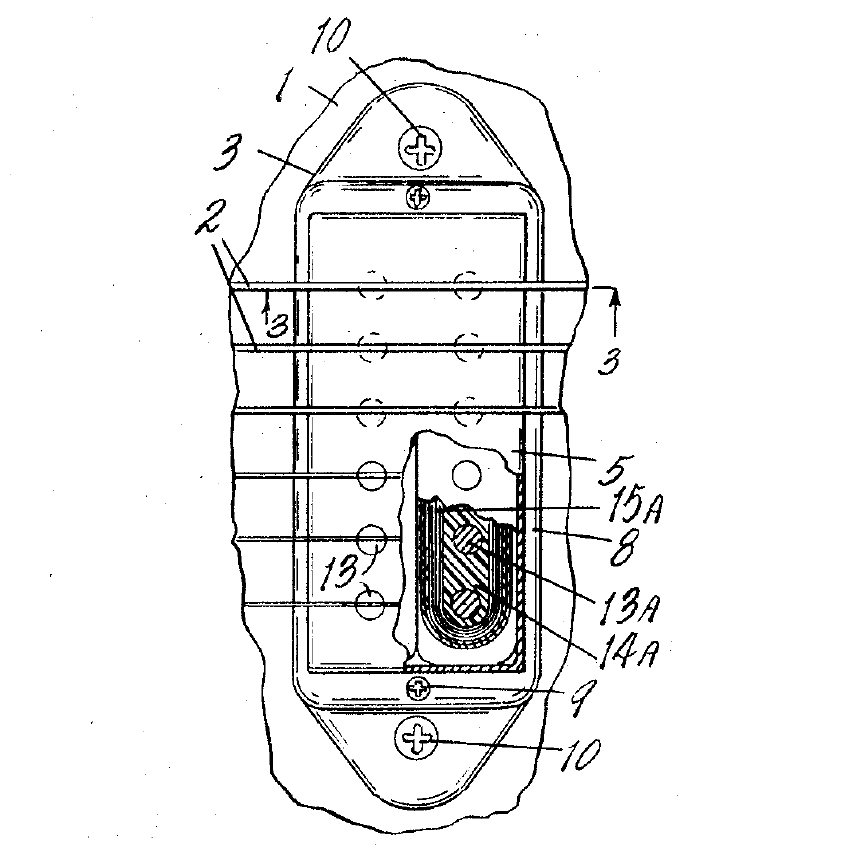
- Rockin’ Patent®:US Patent No. 2,896,491
- Filed: 22 June 1955
- In the name of: E. Lover (assigned to Gibson, Inc.)
- Title: Magnetic Pickup for Stringed Musical Instrument
- What’s claimed: “A magnetic pickup for a stringed musical instrument comprising an elongated permanent bar magnet magnetized from side to side, a plurality of pairs of cylindrical pole pieces of magnetizable soft iron material arranged at spaced intervals along said magnet with the pieces of each pair engaging opposite sides of the magnet and projecting thereabove, a first coil wound around all of the pieces on one side of said magnet, a second coil wound around all of the pieces on the other side of the magnet, one end of each coil being electrically connected to the end of the other with the coils extending in a clockwise direction about each group of pole pieces from the connection, means connected to said coils for connecting the other ends of said coils to an amplifier, and a case of non-magnetic material enclosing said magnet, pole pieces and coils, said case being adapted to be secured to a stringed musical instrument with each string of the instrument passing over a different pair of said pole pieces.”
- Why this patent rocks: Perhaps surprisingly, the vast majority of electric guitars don’t generate an electric signal by way of a microphone. Instead, a “pickup” is provided underneath the strings. A pickup includes a magnet inside a coil made up of many turns of thin wire. When a guitar string vibrates near the magnet, a signal is induced in the coil. The signal is very weak and needs amplification to be useful. Due to the high amplification required, the output from single coil pickups tends to include a lot of noise induced by electrical fields from the surrounding environment. In 1955, Seth Lover (which would make a great heavy metal guitarist name, incidentally) designed a dual coil pickup to address the problem of noise. The two coils were turned in opposite directions around their magnets. Connecting the coils together appropriately caused electrical interference to largely cancel itself out, while generating a higher signal level caused by the moving strings. A side effect of this arrangement is the higher signal output of a humbucker relative to a single coil. This higher output made it easier to drive a guitar amplifier into overdrive, making possible the distinctive saturated, distorted sound of hard rock and metal guitar.
If you’re a patent-savvy music tech business looking for patent help, get in touch with Russell IP here!
The information above is for general interest and information only and does not constitute legal advice.