
- Rockin’ Patent®: US Patent No. 7,942,311
- Filed: 14 December 2007
- In the name of: Frito-Lay North America, Inc.
- Title: Method For Sequencing Flavors With An Auditory Phrase
- What’s claimed: “A method for linking tasting a food product with an auditory phrase, said method comprising the steps of: a) developing a food product having a plurality of flavor notes varying in intensity, duration, and initial perception, whereby a sequence of flavor notes are perceived upon tasting said food product, wherein said food product is marketed in a package, said package containing an indicia of a product identification unique to the food product; b) compiling an auditory phrase having a plurality of components, wherein at least one component is associated with each of the flavor notes of step a); c) accessing an electronic database related to the food product using a device that scans said indicia; and d) playing said auditory phrase on said device in conjunction with the tasting of said food product, whereby the playing of said phrase is initiated at approximately the same time that the food product is initially tasted, thereby matching the auditory phrase with the sequence of flavor notes of the food product.”
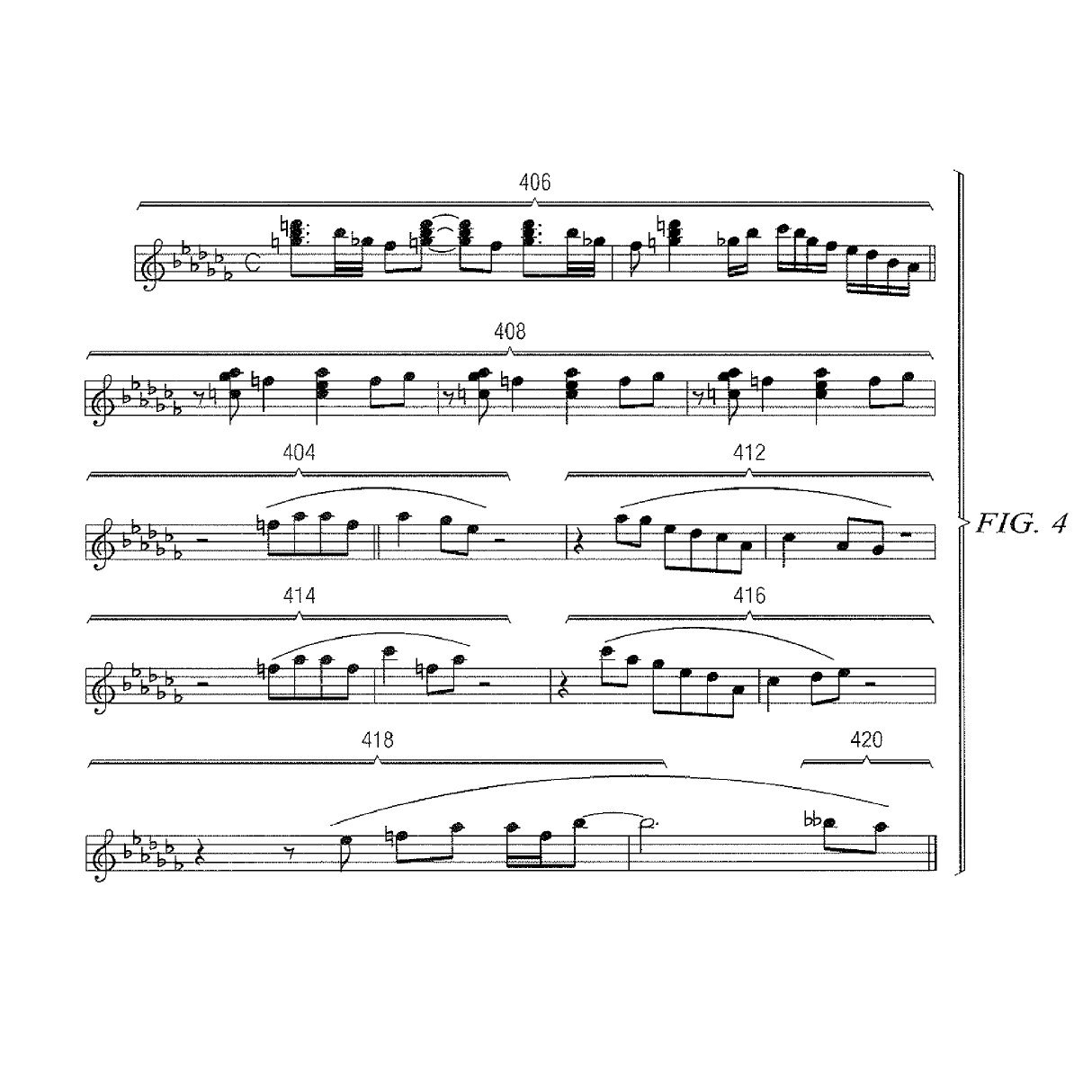
- Why this patent rocks: As described in the Patent: “FIG. 4 [see above] represents an example of an auditory phrase composed to match the salsa verde note sequencing illustrated in FIG. 3. This particular auditory phrase or piece is intended to be played at a tempo of 128 beats per minute. The auditory phrase illustrated by FIG. 4 can be played by, for example, a piano or a full band, or any arrangement of musical instruments that lend themselves to providing the auditory experience desired. The first section 406 is a piano intro and begins upon the consumer’s perception of the cilantro flavoring. During the next section 408 the full band enters. This full band section 408 occurs at approximately the time that the consumer perceives the tomatillo and lime flavors, or starting about 4 seconds from the beginning of the piece. Next comes a first horn melody section 404 starting at approximately ten seconds into the piece, followed by a second melody section 412, which starts at about 13 seconds into the piece. This second melody section 412, along with a third section 414 and a fourth section 416, correspond to the sensation of the heat burn imparted by the Serrano chili. The third section 414 starts at about 17 seconds into the piece, and the fourth section 416 starts at about 21 seconds into the piece. This is followed by a fifth section 418, which starts at about 25 seconds into the piece. Finally, the entire auditory phrase fades out 420 after a total elapsed time of about 28 seconds”.
If you’re a patent-savvy music tech business looking for patent help, get in touch with Russell IP here!
The information above is for general interest and information only and does not constitute legal advice.