
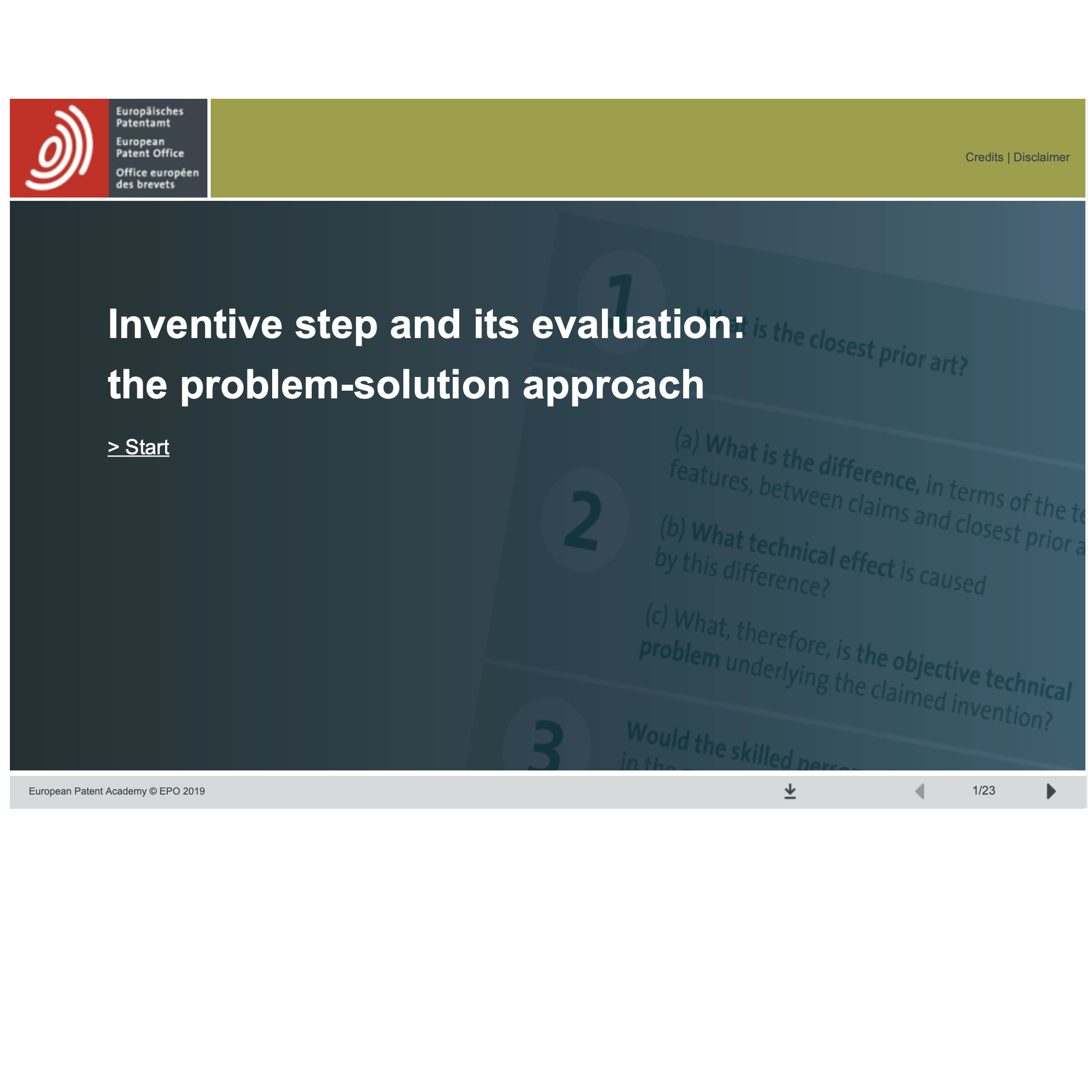
Free EPO e-course On Evaluating Inventive Step Using The Problem-Solution Approach

Inventive step and its evaluation: the problem-solution approach

The European Patent Office (EPO) has some great, free online e-courses, one of which (available here) is on evaluating inventive step using the problem-solution approach (PSA). The PSA is set out in the EPO’s Guidelines For Examination, Part G-VII, 5 (available here). This e-course discusses inventive step, explains the PSA, and includes an exercise to allow you to test your understanding, and application, of the PSA. The e-course is a great read for anyone looking to learn about, or refresh on, the PSA, whether for application in day-to-day practice before the EPO or in the European Qualifying Examination (EQE).

Russell IP has significant experience in patent prosecution work before the EPO and favours thorough, by-the-book responses using the PSA in most cases. If you’re a patent-savvy business looking for help with European (EP) patent prosecution work, get in touch with Russell IP here.

The information above is for general interest and information only and does not constitute legal advice.

Share the Post:

Related Posts

Banner for Russell IP article about Accelerating UK Patent Prosecution

Accelerating UK Patent Prosecution

Accelerating UK Patent Prosecution at the UK IPO: A Practical Guide Introduction Securing a UK patent is usually a long game. On a normal timetable, a UK patent application remains pending for several years before it is granted or finally refused. In many situations, that slow and steady pace is absolutely fine; it gives time to refine the technology, explore markets and spread costs. In other situations, there’s a need for the UK Intellectual Property Office (UK IPO) to move faster. Perhaps a competitor is gearing up to launch a similar product, an investor is asking to see patent grants

Read More
Banner for Russell IP article about guidance on generative AI in patent work

Guidance On Generative AI In Patent Work

New Guidance On Generative AI In Patent Work: Essential Reading For Inventors And SMEs The Chartered Institute of Patent Attorneys (CIPA) and the Intellectual Property Regulation Board (IPReg) have issued new guidance on using generative AI for patent work. In this article, we answer some key questions about the new guidance, and who and what it is for. Why The New CIPA Guidance On Generative AI Matters Generative AI tools are now everywhere. Many inventors and small, innovative businesses are already using them to:  Brainstorm product ideas; Tidy up technical descriptions; Help draft patent-related documents; or Summarise prior art and

Read More

Gain the Competitive Edge

Let's see how we can help protect your IP

Get in touch using the contact form or the phone number below to see how we can protect your IP.

There’s no obligation to sign up for anything.